Search This Blog

Showing posts with label hunger. Show all posts

Monday, March 31, 2014

Gaza: The Hunger Games

The Art of Surviving


Little did the millions who watched “The Hunger Games” film series know that a similar reality actually exists, its not a fictional realm that the creator came up with. Yes, its called “Gaza”. A beautiful little coastal enclave that the least adjectives you can use to describe it are those like “impoverished”, “suffocating” and “Primal”. A little place on the map that suffers from an Israeli imposed siege and is always tightly sealed by Egypt. We can safely and accurately say that Gaza is the biggest modern open-air prison.

You might go through a dilemma or two in your life, but if you live in Gaza, your mere existence is a dilemma in itself. Your life is like a Marionette except its extra polarized and the strings pull you in different directions.

You are expected to aspire for better and higher education, yet thanks to Israel and Egypt you’ll need 10 miracles to get out of Gaza to seek such education. Palestinians are among the most educated and clever nations, we land scholarships so easily (which is supposed to be the hardest part) but visa and border issues always halts the process. Your dream is murdered, sometimes repeatedly.

You read serious reports made by NGOs like UNRWA who say that Gaza wont be livable by 2020, population will grow and life will decline. Many other reports mention the high rates of poverty, water pollution and scarcity, weak infrastructure, unemployment rates skyrocketing, inflation in the population and diseases widespread (like cancer).

Then comes the regular Israeli attacks on Gaza, plus the daily violation of the air space that usually leads to a major headache after all the buzzing and hovering over on low altitudes. People injured or killed, buildings are destroyed, blood is spilled and life is disturbed.

The whole world expected the “Arab Spring” to “blossom” in Palestine, or more particularly, in Gaza. Palestinians living in Gaza have turned into numb robots who are always judged, attacked and bossed around by every other country\nation.
We are asked to topple Hamas. What then? Settle with the PA? No, topple the PA too. Ok, but don’t forget that our main concern is ending the occupation. Yeah, we are expected to also topple the occupation. Wait, so we should end the internal Palestinian division, then topple both factions, then free Palestine? All that while we are hated, judged and attacked by the Egyptian media on a daily basis, which is starting to affect the Egyptian people who are now hating on those who live in Gaza, only because Hamas rules Gaza. Hmmm, collective punishment comes to my mind here, similar to Israel’s way in dealing with Palestinians. Interesting.

Oh, and let’s not forget how we are always judged by the international community. Every Palestinian living in Gaza is considered to be a Hamas member (terrorist) just because it’s the ruling regime, even those who didn’t vote for Hamas, which is highly and very inaccurate and wrong. Nearly two million people reside in Gaza, how is it fair to assume that all of them are Hamas?

As if Gaza isn’t separated enough from the West Bank, and we already feel the internal division and Israeli siege and separation, you have those who live comfortably and safely in their homes abroad and yet sit behind a screen to tell you that Gaza isn’t occupied. Yeah, Israel withdrew, ok, but Israel has a siege imposed and attacks Gaza whenever they have free time or extra fuel. Whatever you say, those people wont change their minds, they don’t know the kind of life you are living.

The US promises and swears to always be Fidus Achates with Israel. Hence AIPAC and all the Israeli domination and prominence. But who will support Palestinians if they aren’t even capable of supporting themselves or each others?

Lets put all that aside for a minute. Lets analyze the daily life here. Due to the high poverty and unemployment rates, people are occupied by making a living. If I had to pick one thing that stands out as the main common factor between Palestinians here in Gaza, or in Palestine, its going to be "HARD WORK". Yes, they just want to earn a living, no matter what it takes.

Rich, middle class, poor and homeless people are always busy making a living or thinking of ways to secure money and put food on the table even if its through street begging. Yes, even rich people here aren’t safe. Plus, those who actually afford to “live a little” rarely do because they are either afraid of the future or feeling guilty. Guilt springs from the horrible situation that explodes by the minute and its all before your eyes.

We are\were slowly trained to adjust to any living situation, no matter how bad it gets. Guinea pigs? Yes. We are opened to any situation. You might think it’s a positive thing, but if you don’t grasp the seriousness of this issue and how dangerous it is, then you’ll never get it. It’s the main reason behind us settling with being mediocre and thinking its okay. Well, its not okay.

We go through daily power outages, 8-12 hours cut, and that’s during the good days. We went through three weeks of no electricity during Israel’s first full-blown war on Gaza. Our sea is polluted with sewage water, so the water is also polluted. You can put two and two together and imagine how all of this highly affects and complicates every aspect of life.

Those who appreciate the beauty and nature of Gaza, or love the “Arts” and decide to defy their families and society by choosing such an understated field that generates no money, are usually ridiculed or accused of living in denial. You find yourself lost between feeling guilty of being hopeful and seeing the bright side, instead of being obsessed 24\7 with the ugliness of the details of life here. God forbid you say Gaza is beautiful, people will say you have gone mad. Even you, in your own mind, you scold yourself for believing in the obvious yet ignoring the common dark side of this same obviousness.

We are resilient. Life doesn’t stop here. But we don’t realize how much we are paying for this resilience. A very high price, in such a harsh era we live in. We are losing our humanity. We are becoming rude, inconsiderate and cutthroat. I wish this was a desultory fact, but it isn’t. We are detaching and becoming despondent. We are becoming less human and more animal-like who are only bothered by surviving in the forest.

If you yearn for a normal life in Gaza, you are in big trouble. Life can never be normal here, and if you try and live a normal life, you’ll be abnormal. People will judge you and make you feel less patriotic or passionate about your country. If you ever craved traveling for vacation, forget it, both Erez and Rafah are journeys from hell, assuming ofcourse you were lucky enough to have 10 miracles that might secure you a chance of exit.

If you yearn to Jerusalem, then wait till you are 50, or till you are very sick or you are blessed with a good job at one of Gaza’s many useless NGO’s who milk the Palestinian cause and launch huge donation campaigns with no real effect on ground. Or else, Israel won’t let you past Erez.
If you have best friends in the West Bank, then plan a meeting in any country but Palestine, for a chance to see them, only if Egypt has Rafah opened and you are okay with humiliation and being treated like a herd of sheep.

If you live in Gaza and you want to excel, then good luck and may God be on your side. With very few opportunities around, little resources and no major organization to support you, the competition is really high, like really really high and super tough, cutthroat. You have to shine brighter than the sun to be recognized.

If you live in Gaza, you realize that you CAN NOT live in it and you CAN NOT live out of it. When you are in, you will yearn to go out, and when you are out you will die to get back in to your family and your land. You are destined to a polarizing life. You are required to master the art of survival.

If you live in Gaza, you should smile and move on, but hold on very tightly to your humanity and everything that makes you the way you are. Live, love, be happy and be sad. See the obvious, with all its colors\shades\sides. Try to be a bit normal, but be clever enough to recognize that you will never be completely normal. Be humane, be you and be strong. Lets survive, without turning our surroundings into a jungle. Lets keep dreaming of a better world.

With love,
Omar Ghraieb

Wednesday, December 25, 2013

Samer Issawi is free, renewed belief in popular & nonviolent resistance

Samer Issawi is free, renewed belief in popular & nonviolent resistance


Gaza, December 25, Samer Tariq Issawi, born December 16, 1979 in Issawiyeh, north east of Jerusalem, is a Palestinian iconic hero of nonviolent resistance. On 15 April 2002, Samer was arrested by the Israeli army in Ramallah as part of “Operation Defensive Shield” during the Second Intifada alleging he was affiliated with the Democratic Front for the Liberation of Palestine.

Nearly 10 years later, in October 2011, Issawi, then serving the ninth year of a 30-year jail sentence, he was released along with 1027 Palestinian prisoners as a result of an Egypt-brokered deal between Hamas and the Israeli government for the return of Gilad Shalit, Israeli soldier kidnapped by Hamas on Gaza’s borderline. However, on 7 July 2012, he was arrested again.  His lawyer Andre Rosenthal stated that he had been taking his car to be fixed at a garage in the West Bank.

He was convicted of an 8 months sentence so he went on an open hunger strike since August, 2012.

Palestinian political prisoner and resistance icon Samer Issawi was released on Monday after spending over 17 months in the Israeli occupation detention centre Shatta Prison.
"Samer Issawi's family was ordered by Israeli terror police earlier today not to celebrate and to take down the flags raised at their home," according to The Free Samer Issawi Campaign page on Facebook.

Issawi ended his 265+ day long hunger strike on 23, April 2013 after accepting a deal brokered by Israeli and Palestinian officials to serve eight months on charges of violating bail conditions for an earlier release.

The law, which has been in place since the end of the British mandate in Palestine in 1948, allows for the arrest of Palestinians if they are deemed a "threat" to Israel's national security.
 Palestinian hunger strikes have posed a new challenge to the Israeli government, which has come under international criticism for its practice of detaining prisoners without trial.

Samer endured hell from his warders happen to be the occupiers of his land. They tried every possible physical and mental torture strategies to stop him from hunger striking but they failed. He stayed strong, he represented steadfastness and preferred death than giving in to injustice.
Samer said it loudly to the Electronic Intifada: “ I would prefer to die on my hospital bed to being deported from Jerusalem. Jerusalem is my soul and my life”, and he meant every word. He defied occupation with nothing but an empty stomach and won, he never compromised. They offered him a deal of being released and exiled to Gaza, he refused, he insisted on returning back home to Jerusalem and he got what he wanted. His defiance gave hope to the Palestinian masses inside and out of Palestine, he reignited the spark of popular resistance and proved that nonviolent resistance actually works. His release inspired festivities and celebrations across Palestine.

Samer’s family got popular too, they showed the same defiance when they talked to the media but the rising star was his sister Shireen Issawi, who represented the strength of Palestinian women. Shireen never gave up, she fought viciously for her brother on social media and stood by him every step of the way. Shireen became a role model and a symbol of strength and endurance, just like her brother.
Medhat Issawi, brother of Samer Issawi, was released only a few days before Samer after spending nearly 20 years off and on in Israeli jails for participating in protests and intifadas.

It was definitely a happy day for Palestine and a historic one nonetheless. Gaza united with the West bank and was anxiously waiting for Samer’s release. It was a national celebration and Gazans made sure they are a part of it and sent their love and support to the Issawi family even though many couldn’t track his release through live coverage due to daily power outages.

Samer Issawi is free, Palestine will be free.


Tuesday, April 23, 2013

Tell the world: Samer Issawi is coming home

Samer Issawi is coming home

(A poem I wrote for Samer is at the bottom of this post)

Gaza, April 23, Samer Issawi is set to be released 8 months from now.In a brokered deal between the Israeli authorities and Samer's lawyer and family, Samer Issawi will serve another 8 months starting from today and then be released and back to his home with no conditions or any foreign exile.

Rumors have been spreading online for a while about so many deals with so many different details but this deal was confirmed by Samer's family and lawyer, which means that it will happen if Israel doesnt break its promise and slam the deal against the wall. Its noteworthy that Israel is unpredictable and doesnt keep promises, so lets pray and hope and see.

Samer Issawi was released back in October of 2011 as a part of Shalit's release deal. Israel released 1027 Palestinian prisoners in return of Hamas's release of Israeli soldier, Gilad Shalit.

Israel then re-captured Samer Issawi in 2012 and held him with no charges or trial. Samer started hunger striking for freedom and till yesterday he passed over 8 months of hunger striking breaking any world record out there. No word yet whether Samer ended his hunger striking or not, but he went back to taking his Vitamins after stopping for a day or two in a step of escalation. 

Samer Issawi has seen unprecedented support from inside and outside of Palestine, people everywhere stood by him and showed support by taking the streets and hunger striking in support of him and honoring him in a way by appreciating his bravery.

Samer Issawi's family, especially his sister Shireen who works as a lawyer, played a great role in imposing pressure and raising awareness about Samer's case. Social media also helped in channeling support and creating awareness and pressure.

Perhaps Samer Issawi's release is the most anticipated event in Palestine these days. This is a picture of Samer Issawi's mother after hearing about the deal of her soon-to-be released son:


In 8 months from now, and only a week before 2014, Samer Issawi will be released and back with his family so Palestine can enter a new year full of hope and anticipation for freedom and justice.

Samer Issawi turned into an iconic figure, a hero and a representative of Palestine's steadfastness and strength for choosing to starve himself for freedom. Palestinians look up to him for he has given them hope and faith in a better tomorrow, Samer will be free and Palestine will be free.

Samer Issawi lost allot of weight and his health is in mere danger, he will need a long rehabilitation time after his release to revive his weak body who kept fighting while being fueled with a strong will and a thirst for freedom.

 You were born to fly
With a strong will
And a head held up high
And steal wings

You were free before humanity came
A hero with a special name
A truth stronger than a claim
bringing your jailers to shame

Your mother prayed and prayed
you were never afraid
you knew you would win
you knew you would prevail

Your body is weak
But your soul is not harmed
You will soon be released
Received with cheers and open arms

No matter who doubts or hates
No matter what it takes
The world awaits
For you to come home

You are coming home
To where you belong
To Jerusalem 
To the rock covered by a dome


From Gaza with love and hope,

Omar


Sunday, February 26, 2012

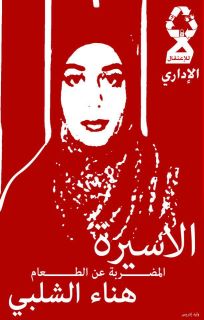
We supported Khader Adnan NOW lets support Hana Shalabi

We supported Khader Adnan NOW lets support Hana Shalabi


Khader Adnan is a name that made history, he is a Palestinian hero who won his battle for his dignity and he won over injustice and cruelty. He was illegally detained after he was kidnapped from his bed by Israeli police; he started a hunger strike to protest against his illegal administrative detention. He ended his hunger strike after 66 days after his lawyers accepted a deal offered by the Israeli military court to release him in April. Israeli police said that Khader Adnan’s illegal arrest was done for classified and secretive reasons that they don’t want to share. YEAH RIGHT. Numerous Palestinian prisoners go and went through the same torture. They will get arrested for classified reasons and just remain illegally detained until further notice.

Khader Adnan isn’t released yet. We should keep fighting until he is released then keep fighting for others like Khader Adnan. Now its time we show the same concern and care for Hana Shalabi. Hana Shalabi entered her 11th day of hunger strike. I was searching for info about Hana Shalabi and found this valuable info about Hana shared by Anan Odeh:

Hanh Shalabi was among more than 1,000 Palestinian prisoners released in October in a trade for Israeli soldier Gilad Shalit. Hana was re-arrested on February 16 2012 and ordered to be detained without trial for six months - administrative detention. She decided to protest her arbitrary detention sam way as the hero Khade Adnan and today she is on the ninth day of her open hunger strike. She needs our immediate support, I believe that every one can do something to emphasize her cause and to make a pressure at the right time - before it is too late - to have her released. Please distribute the story widely and I will do my best to keep you updated.

 Here is her profile from the previous arbitrary detention, so you can learn something about her and about how she suffered that time:

 HANA YAHYA SHALABI

Date of birth: 2 July 1982
Place of detention: Hasharon prison
Date of arrest: 14 September 2009
Place of residence: Burqin, Jenin
Number of order renewals: One
Expected end of administrative detention order: 12 September 2010

Date of release: Hana was released on 18 October 2011 as part of the prisoner exchange deal concluded by the Israeli government and Hamas authorities

ARREST AND INTERROGATION Hana Yahya Shalabi was arrested from her family home on 14 September 2009. At approximately 1:30 a.m. that morning, Israeli soldiers in 12 military jeeps surrounded her house in Burqin village, near the West Bank town of Jenin. The soldiers ordered Hana’s entire family outside of the house and demanded Hana give them her identity card. They then proceeded to conduct a thorough search of the family’s home. During the search, one of the soldiers forcibly removed framed pictures of Hana’s brother Samer, who was killed by the Israeli army in 2005, tore them apart and walked over the pieces in front of the entire family. The soldiers then started shouting and cursing at Hana and her family members. When Hana’s father, aged 63, attempted to intervene and protect his daughter from continued verbal abuse, one Israeli soldier pushed him in the chest with the butt of a rifle. Clearly distressed, Hana’s mother fainted at this scene. The soldiers then handcuffed Hana in painfully tight shackles around her wrists and placed her under arrest.  Hana was then transferred by military jeep to Salem Detention Center. During the transfer, Hana’s abaya, a traditional Muslim religious dress covering the entire body worn by women over home clothes, came open, uncovering her clothes and parts of her body. Some of the male soldiers accompanying her in the jeep took pictures of her at this point, consciously exploiting her situation, knowing she would feel offended and humiliated by such photos. Upon arrival to Salem Detention Center, a doctor gave Hana a quick physical examination. Immediately after the examination, Hana was transferred to Kishon Detention Center inside Israel where her interrogation formally began. 

Solitary confinement and abuse Hana was held in solitary confinement at Kishon Detention Center for eight consecutive days, in a cell measuring six square meters that contained no windows or natural sunlight. The cell contained only a mattress and a bathroom, and was reportedly very dirty. Hana was subjected to exhausting interrogation sessions every day, which lasted from 10:00 a.m. until the late evening hours. The lack of natural sunlight during this period caused her to lose all sense of time and she was often unable to determine whether it was night or day. As this period of isolation and disorientation coincided with the holy month of Ramadan, 

Hana was unable to monitor time in order to respect her fast. As a result, she decided not to eat at all, refusing meals and drinking water only during the entire eight day period.   Hana was also subjected to sexual harassment and physical violence during her interrogation. Hana told Addameer attorney Safa Abdo of an incident that occurred at end of an interrogation session, in which she did not confess to committing a crime, as her interrogators had expected. In a move that Addameer contends was an effort to provoke Hana, one of the Israeli interrogators called Hana “habibti” (Arabic for “darling”) in a provocative manner.   Feeling humiliated and angry at the interrogator’s offensive use of an intimate term, Hana started shouting at him. The interrogators responded by slapping her on her face and beating her on her arms and hands. The guards then took her back to her cell where they tied her to the bed frame and continued humiliating her by taking pictures of her laying in that position.   

Addameer is greatly concerned by the verbal abuse Israeli detaining authorities display towards Palestinian female prisoners by directing sexual threats towards them and using inappropriate, vulgar language. Addameer contends that this behavior is done in a deliberate effort to exploit Palestinian women’s fears by playing on patriarchal norms as well as gender stereotypes within particular customs of Palestinian society. 

ADMINISTRATIVE DETENTION After Hana’s interrogation period concluded, she remained in Kishon Detention Center for nine additional days, which Israeli authorities claimed were necessary for the purpose of investigation.   On 29 September 2009, Israeli Military Commander Ilan Malka issued a six-month administrative detention order against Hana on the premise that she posed a threat to the “security of the area”. The order was set to expire on 28 March 2010. At the judicial review of the order, which took place on 5 October 2009 at the Court of Administrative Detainees in Ofer Military Base, near the West Bank city of Ramallah, military judge Ilan Nun confirmed the order for the entire six month period, but agreed to count the two weeks Hana had already been detained towards her detention period. In his decision, Nun alleged that, based on the “secret information” made available to him by the military prosecution, Hana was intending to carry out a “terrorist attack”. The judge further claimed that Hana had already undertaken initial steps in preparation for the attack, though he provided no proof to support this allegation.   Addameer contends that the judge’s decision raises serious questions and fair trial issues. 

Seventeen days of investigation by the Israeli Security Agency, including eight days of consecutive interrogation did not prove the suspicions against Hana and no evidence of the alleged “intention” was brought before the court. Moreover, at no point did the court establish Hana’s affiliation with a Palestinian political party or armed group, nor did it establish whether Hana planned to carry out the alleged attack by herself or in partnership with anyone else. Additionally, the nature of a possible partnership was never investigated. Importantly, all suspicions directed towards Hana remained vague and general, leaving her without any legitimate means to defend herself. Although administrative detention orders issued by the Israeli military commander are the subject of review and further appeal by a military court, neither lawyers nor detainees are permitted to see the 'secret information’ used as a basis for the detention orders, rendering any possible legal defense meaningless.   Hana’s attorneys filed an appeal against her administrative detention order, but the appeal was refused. Hana is now set to be held without charge or trial until 13 March 2010. 

DETENTION CONDITIONS Prior to her transfer to HaSharon Prison, Hana spent a total of 17 days in Kishon Detention Center, where she was not once given a change of clean clothes. Hana continued to be detained in interrogation-like conditions for three days after her administrative detention order was issued. On 1 October 2009, she was eventually transferred to Section 2 of HaSharon Prison, where, due to overcrowding, she was placed in the same section as female Israeli criminal offenders. This placement is a direct violation of Israeli Prison Service Regulations, which stipulate that administrative detainees are to be held separately from all other detainees and prisoners, including those who have been convicted of a crime. Moreover, detained in the same sections as Israeli criminal offenders, Palestinian female prisoners are almost always discriminated against, enjoy fewer recreation hours and are often subjected to humiliation and abusive language from Israeli prisoners, who threaten them of physical attack. As a result, Palestinian women live in constant fear and often experience insomnia, and other psychological problems for the entire time they are detained in the same sections with Israeli women.   

Addameer attorney Safa Abdo filed a complaint with the HaSharon Prison administration regarding Hana’s detention conditions. On 25 October 2009, after being held for 25 days among Israeli criminal offenders, Hana was finally moved to Section 12 of HaSharon Prison with the other Palestinian female prisoners, where she was held together with approximately 18 other Palestinian female prisoners. The building which now constitutes the prison complex served as the headquarters of the British Mounted Police during the British Mandate in Palestine and, as such, was never designed for the incarceration of women. As a result, Hana suffered from the harsh detention conditions and complained of overcrowding, humidity, lack of natural sunlight and adequate ventilation, as well as poor hygiene standards.(1)  

PERSONAL INFORMATION Prior to her arrest by the Israeli authorities, Hana was arrested and held by the Palestinian intelligence forces for a week in 2009 for the purpose of interrogation. During this period, Hana was permitted to sleep at home and was kept in detention from 9:00 a.m. until 11:00 p.m. each day.   Hana is one of nine children in a family of farmers in Burqin village, next to Jenin. On 29 September 2005, Hana’s brother Samer was killed by Israeli forces during an incursion in the village. Although Hana never intended to pursue university studies after completing her secondary education, she now vows to study journalism after she is released to advocate for the rights of Palestinian prisoners.   

Administrative detention is a procedure that allows the Israeli military to hold detainees indefinitely on secret evidence without charging them or allowing them to stand trial. In the occupied Palestinian West Bank, the Israeli army is authorized to issue administrative detention orders against Palestinian civilians on the basis of Military Order 1591. This order empowers military commanders to detain an individual for up to six month renewable periods if they have “reasonable grounds to presume that the security of the area or public security require the detention.” On or just before the expiry date, the detention order is frequently renewed. This process can be continued indefinitely.

Please use your voice, platforms, social media accounts ....etc to be the voice of Hana Shalabi. Join twitter campaigns in support of Hana Shalabi. 

Follow @Addameer_ps and @KhaderAdnan for more info.


Join tomorrow's demonstration in Ramallah at 5 pm. 

You can join Addameer's campaign to STOP ILLEGAL DETENTION by checking out this link that shows you what to do and who to contact: